Bikes Left on the Lawn Until Dinner. The Childhood That Quietly Got Locked Indoors.
Bikes Left on the Lawn Until Dinner. The Childhood That Quietly Got Locked Indoors.
Ask anyone who grew up in America before 1990 to describe a summer day from their childhood and the details follow a pattern. Out the door after breakfast. A loose pack of neighborhood kids. Bikes, creeks, vacant lots, construction sites that absolutely weren't safe. Home when your mom yelled from the porch or the streetlights came on — whichever came first. No one knew exactly where you were. No one really needed to.
That version of childhood — chaotic, unsupervised, geographically expansive — is now so rare it has acquired a brand name. "Free-range parenting" is what people call it when they try to revive it today, as though letting a nine-year-old walk to the park alone is a lifestyle philosophy that requires a label rather than just a Tuesday afternoon.
Something shifted. The question is what, exactly — and whether the shift actually made children safer, or just made their parents feel like it did.
The Geography of a Kid's World
In 1970, the average American child's independent roaming range — the area they could move through without adult supervision — was roughly a mile from home. By 2000, studies suggested that range had shrunk to a fraction of what it once was. One widely cited British study tracked the same family across four generations and found that the distance children traveled independently had collapsed by roughly 90 percent over that span. American data tells a similar story.
In the 1970s, about 48 percent of American kids walked or biked to school. Today, that number sits closer to 13 percent. Youth sports participation has actually increased over the same period — but the nature of that activity shifted from informal, kid-organized games in the backyard to adult-coached, scheduled, uniformed leagues with standings and tournament travel.
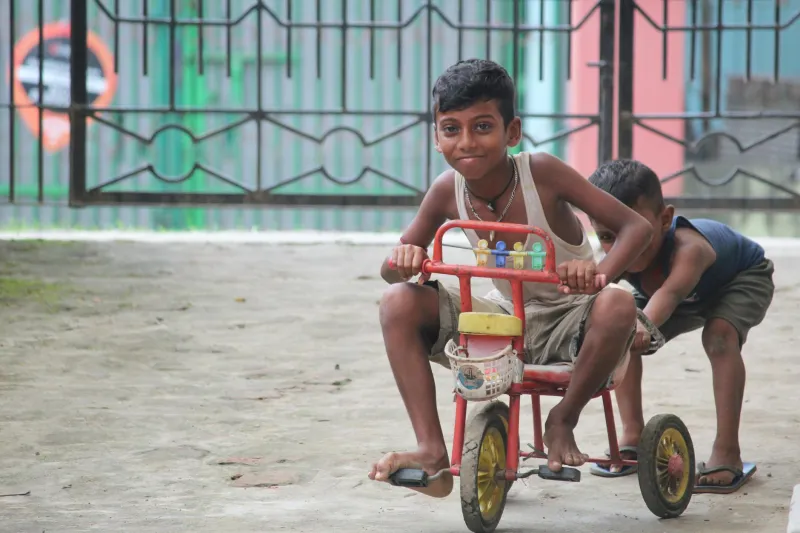
The bike didn't disappear. It just stopped being transportation and became equipment.
The Panic That Changed Everything
If you want to identify a single cultural moment that accelerated the shift, the disappearance of Etan Patz on a New York City street in 1979 is where most historians of childhood point. Etan was six years old, walking alone to his school bus stop for the first time, when he vanished. His face became one of the first to appear on a milk carton — a campaign that turned the image of missing children into something millions of Americans encountered at the breakfast table every morning.
The message was powerful and, in important ways, misleading. Child abductions by strangers are genuinely rare. They were rare in 1979, and they're rare now. The statistical risk of a child being abducted by a stranger on an American street is vanishingly small — far lower than the risk of a car accident, which is itself quite low. But statistics don't move people the way stories do, and the story the media told through the 1980s and 90s was one of lurking danger, predatory strangers, and children who needed constant protection.
The 24-hour news cycle, which came of age in the 1990s, amplified every abduction story to national scale. When every rare tragedy receives saturation coverage, the brain begins to process rare events as common ones. Parents weren't irrational for responding to what they were seeing and hearing. They were responding entirely rationally to a distorted picture.
The Helicopter Didn't Build Itself
Media coverage was the accelerant, but the fire had other fuel.
American suburbs were redesigned in the postwar decades in ways that made independent child movement less natural. Cul-de-sacs replaced through-streets. Sidewalks disappeared from newer developments. The mixed-use, walkable neighborhood — where kids moved fluidly between houses, corner stores, and parks — gave way to car-dependent layouts where a child on foot was conspicuous.
Working patterns changed too. As dual-income households became the norm, the informal neighborhood supervision network — the stay-at-home parents and grandparents who had always provided ambient oversight of the block's children — thinned out. In its place came organized childcare, structured after-school programs, and the managed playdate, each one a reasonable response to a genuine need.
Legal and social pressure completed the picture. Parents who allow their children genuine independence today risk something their counterparts in 1975 never did: a call from child protective services. Several high-profile cases in the 2010s involved parents being investigated or charged for allowing children to walk to parks alone or stay home unsupervised. The legal risk is modest in most states, but the social judgment is real and immediate.
What the Research Actually Says
Here's the uncomfortable part: the evidence that restricting children's independence made them meaningfully safer is thin. Child mortality rates have declined sharply since the 1970s, but the improvements are almost entirely attributable to car safety improvements and better medical care — not to supervised childhoods.
What the research does suggest, with growing consistency, is that unstructured outdoor play — the kind that requires children to negotiate conflict, assess risk, and entertain themselves without adult direction — builds the kind of resilience, creativity, and social competence that structured activities struggle to replicate. The scrape from falling out of a tree turns out to have developmental value that's harder to manufacture in a scheduled environment.
Rates of childhood anxiety and depression have climbed significantly since the 1990s. Researchers debate causation, but the correlation between declining independence and rising anxiety is one thread that keeps appearing in the literature.
The World Didn't Get More Dangerous. Our Tolerance for Risk Did.
The honest reckoning here is that American childhood didn't get safer when it moved indoors — it got more legible. More trackable. More manageable from a parental anxiety standpoint. Those are real benefits for real people, and dismissing them entirely misses how genuinely frightening the world can feel when you're responsible for a child.
But something was lost in the transaction. The kid who got lost on their bike and found their way home. The afternoon that had no agenda. The negotiation with other kids over rules that no adult had written. Those experiences weren't just fun — they were formative in ways that a calendar full of supervised activities can't quite replicate.
The streetlights still come on at the same time every evening. Fewer kids are watching for them.