The Hour That Disappeared: When America's Lunch Break Actually Meant Something
The Hour That Disappeared: When America's Lunch Break Actually Meant Something
At exactly 12:00 PM, the office building would empty. Not gradually, not partially—it would empty. Workers would push back their chairs, grab their coats, and head out into the world for an hour that belonged entirely to them. The lunch break wasn't just a meal; it was a daily ritual of disconnection, conversation, and genuine rest.
That world is gone now, and most of us ate our way through its disappearance without even noticing.
When Lunch Meant Leaving
In the 1950s and 1960s, the lunch break was as standard as the 40-hour work week. It wasn't negotiable, it wasn't optional, and it certainly wasn't something you did while staring at a computer screen. Workers left their desks at noon and didn't return until 1:00 PM. Period.
The ritual had weight. Men would straighten their ties, women would touch up their lipstick, and everyone would head to the diner down the street or the cafeteria in the building's basement. They sat in booths, ordered from waitresses who knew their names, and talked about everything except work. The cash register rang, coffee percolated, and for sixty precious minutes, the office might as well have been on another planet.
Restaurants built their entire business models around this predictable flood of customers. Lunch counters specialized in meals that could be ordered, prepared, eaten, and paid for within that sacred hour. The "blue plate special" wasn't just affordable—it was engineered for the working person's schedule.
The Great Acceleration
Something shifted in the 1980s and 1990s. Maybe it was the rise of corporate culture, maybe it was the glorification of being "busy," or maybe it was just the slow creep of efficiency above all else. Whatever caused it, the lunch break began to shrink.
First, it became acceptable to eat at your desk "just this once" when a deadline loomed. Then that exception became more common. Soon, leaving the office for lunch started to feel almost indulgent—like you weren't committed enough, weren't hustling hard enough.
The technology didn't help. Computers made it possible to work through lunch. Email made it seem necessary. And smartphones made it unavoidable. Why waste time sitting in a restaurant when you could knock out a few more tasks?
The Sad Sandwich Era
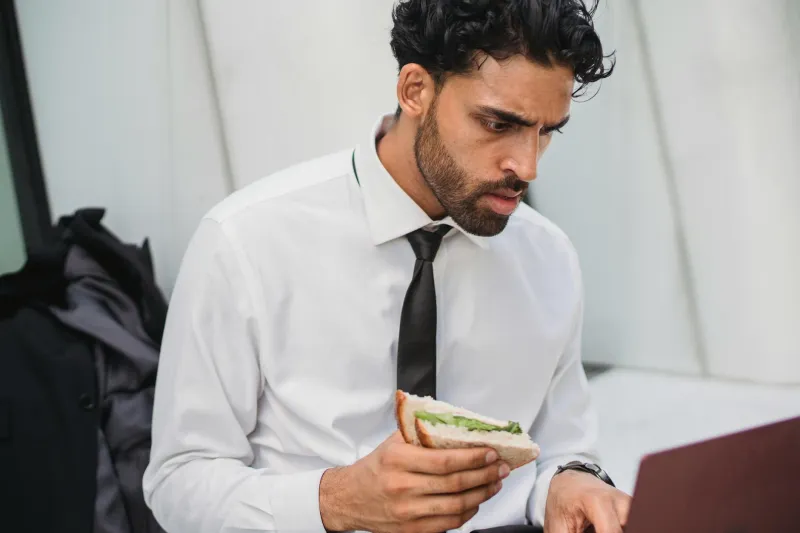
Today's lunch break—if it exists at all—is a shadow of what it used to be. We grab something from the office kitchen, unwrap it at our desks, and eat while scrolling through emails or attending virtual meetings. The average American lunch break has shrunk to just 30 minutes, and many workers don't take even that.
Walk through any office building at noon today, and you'll see the evidence everywhere: people hunched over keyboards with takeout containers beside them, conference rooms filled with people eating while presenting PowerPoints, kitchen areas where workers grab yogurt and rush back to their desks like they're stealing time.
The restaurants that once thrived on the lunch crowd have adapted or died. Diners became fast-casual chains. Sit-down meals became grab-and-go. The leisurely lunch became the power lunch, and then even that became the working lunch, and finally just another email you eat through.
What We Lost in Translation
It's easy to dismiss the old lunch break as inefficient, a relic of a slower time when productivity mattered less. But that misses what those sixty minutes actually provided.
The lunch break was a mental reset button. It forced people to step away from their work, to let their minds wander, to have conversations about life instead of quarterly reports. It was a daily reminder that work was something you did, not something you were.
Those conversations in diner booths weren't just social—they were how office relationships formed, how ideas cross-pollinated, how workplace culture actually developed. The informal networks that made organizations work were built over coffee and pie, not in conference rooms.
And the simple act of leaving the building, of walking outside, of sitting somewhere different—that wasn't wasted time. It was restoration. It was the pause that made the afternoon possible.
The Productivity Paradox
The irony is that our lunch-free culture might not even be more productive. Studies consistently show that people who take real breaks—who actually step away from their work—perform better, think more creatively, and make fewer mistakes. The brain needs downtime to process information and generate insights.
But we've created a culture where taking that downtime feels like slacking. Where eating lunch away from your desk feels like a luxury. Where the idea of spending a full hour not thinking about work feels almost rebellious.
The Clock That Never Stops
The disappearance of the lunch break reflects something larger about how we work now. The boundaries that once existed—between work time and personal time, between office space and living space, between being available and being off—have all blurred or vanished entirely.
We carry our offices in our pockets. We check emails at dinner. We take calls on weekends. The lunch break was one of the last daily rituals that enforced a boundary, that said "work stops here, even if just for an hour."
Without it, the workday has become a continuous stream, interrupted only by sleep. And even that's not guaranteed, given how many people check their phones before their feet hit the floor in the morning.
What We Can't Get Back
The old lunch break isn't coming back. The economic pressures, the technology, the culture—it's all moved too far in the other direction. But understanding what we lost might help us figure out what we need to build back.
Maybe it's not about recreating the exact ritual of the 1960s lunch counter. Maybe it's about recreating the principle: that rest isn't weakness, that boundaries aren't inefficiency, and that the best work often happens when you step away from it.
The hour that disappeared took more with it than just the time to eat a proper meal. It took the idea that our days should have rhythm, that work should have limits, and that sometimes the most productive thing you can do is absolutely nothing at all.