When 6 O'Clock Meant Everyone Gathered: How America Abandoned the Sacred Hour of Dinner
The Clock That Ruled America's Evening
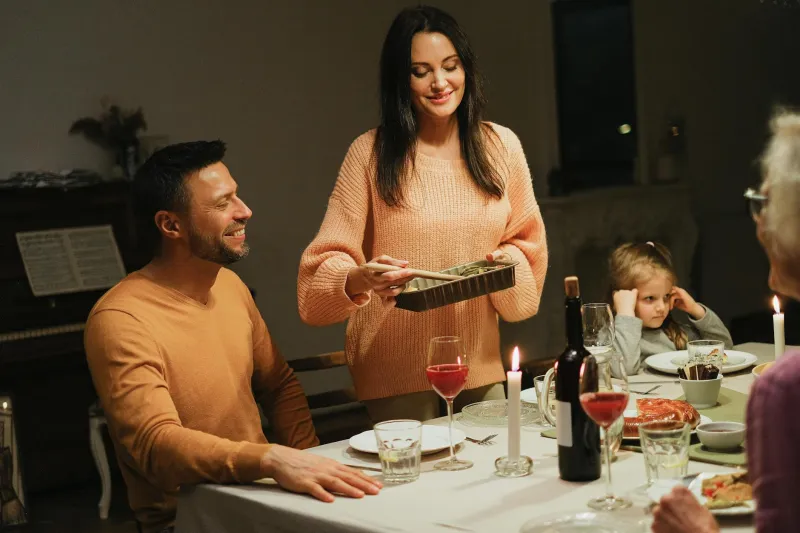
In 1955, if you walked down any residential street in America at 6 PM, you'd notice something remarkable: the sidewalks were empty. Not because people weren't home, but because they were all doing the exact same thing at the exact same time. They were sitting around their dining room tables, sharing a meal that Mom had been preparing since 4 o'clock.
This wasn't just dinner. It was a daily ceremony that structured the rhythm of American family life for generations. The evening meal was as predictable as the sunrise, and just as essential to the natural order of things.
Today, that world feels as foreign as a black-and-white photograph.
When Dinner Was an Event, Not a Task
The family dinner of the 1950s and 60s operated on a completely different logic than today's eating habits. Dad arrived home from work at 5:30. Mom had timed the pot roast to finish at exactly 6:00. The kids knew to wash their hands and take their assigned seats. The television stayed off. The phone went unanswered.
This wasn't about food—it was about order. The dinner table was where families synchronized their lives, shared their days, and reinforced their connection to each other. Children learned table manners, conversation skills, and family values in those 45 minutes between grace and dessert.
Meals were planned days in advance. Sunday's pot roast became Monday's hash, Tuesday's soup, and Wednesday's sandwiches. Nothing was wasted, and every meal had its place in a weekly rhythm that everyone understood. The dinner table was the family's daily meeting, their news exchange, their conflict resolution center.
The Slow Unraveling of the Sacred Hour
The dismantling of the family dinner didn't happen overnight. It was death by a thousand cuts, each one seeming reasonable at the time.
First came the changing work schedules of the 1970s and 80s. As more mothers entered the workforce and fathers began working longer hours, that predictable 6 PM convergence became harder to maintain. Families started eating in shifts—Dad at 7, kids at 5:30, Mom whenever she could grab a moment.
Then came the explosion of after-school activities. Soccer practice, piano lessons, and dance classes scattered family members across town during the traditional dinner hour. The minivan became a mobile dining room, with drive-through bags passed between car seats.
The microwave, introduced to American kitchens in the 1970s, promised to save time but ended up fragmenting meal times even further. Why wait for everyone to gather when you could heat up individual portions whenever someone got hungry?
By the 1990s, the rise of cable television and personal computers meant that even when families were home together, they weren't really together. The dining room table became a homework station, a mail sorting area, or simply a piece of furniture that collected dust.
The McDonald's Generation Grows Up
Today's eating culture would be unrecognizable to a 1950s family. Americans now eat roughly 20% of their meals in cars. The average family sits down together for a meal just three times per week. When they do gather, the average dinner lasts 12 minutes—barely enough time for everyone to finish chewing.
Restaurant portions have tripled in size since the 1950s, but paradoxically, we eat more meals alone than ever before. The phrase "family dinner" now often means takeout containers consumed while staring at individual screens.
Food has become fuel rather than fellowship. We eat breakfast bars while commuting, lunch at our desks while working, and dinner while scrolling through our phones. The idea of stopping everything for a shared meal feels almost quaint—like suggesting we all gather around the radio for evening entertainment.
What We Lost When We Lost the Table
Research has revealed what our grandparents knew instinctively: something important happens when families eat together regularly. Children who grow up with frequent family dinners have better academic performance, lower rates of depression, and stronger communication skills. They're less likely to engage in risky behaviors and more likely to maintain close family relationships as adults.
But the benefits went beyond the children. The daily dinner ritual created a natural pause in the adult day—a forced break from work stress and external pressures. It provided structure in an increasingly chaotic world and maintained family hierarchies and traditions that might otherwise dissolve.
The dinner table was also where children learned the subtle arts of conversation, conflict resolution, and social navigation. They discovered how to tell a story, how to listen, how to disagree respectfully. These weren't formal lessons—they were absorbed through daily practice.
The Modern Attempt to Recreate Magic
Today's parents often feel guilty about the scattered nature of their family's eating habits. They try to recreate the family dinners of previous generations with mixed success. Meal kit delivery services promise to bring families back to the table. "No phones at dinner" rules attempt to recreate the focused attention of the pre-digital era.
But these efforts often miss the point. The power of the traditional family dinner wasn't just in the gathering—it was in the predictability, the shared investment, and the understanding that this time was sacred. It was embedded in a broader culture that prioritized family time over individual convenience.
The Dinner Table as Time Machine
The decline of the family dinner represents more than just a shift in eating habits. It reflects the broader transformation of American family life from collective to individual, from scheduled to spontaneous, from ritualistic to utilitarian.
We've gained flexibility, convenience, and personal choice. But we've also lost something that previous generations took for granted: a daily reminder that we belong to something larger than ourselves, served up one shared meal at a time.
The empty dining rooms of modern America tell the story of a culture that chose efficiency over connection, and we're still figuring out what that trade-off really cost us.