From the Kitchen Chair to the Gleaming Chain: How American Dental Care Got Better and Worse at the Same Time
There's a particular kind of dread that older Americans still carry in their bodies when they walk into a dentist's office. Not just the usual anxiety about drills and needles. Something deeper. A muscle memory of a time when dental care wasn't a scheduled appointment with a trained specialist in a climate-controlled suite. It was something that happened to you, often without warning, sometimes in a room that had nothing to do with medicine.
For a significant stretch of 20th century American life, a toothache was less a medical event and more a test of endurance.
The Tooth-Puller Down the Road
In rural and working-class America through the 1940s and into the 1950s, dedicated dental care was a luxury most families simply didn't have access to. Dentists existed, of course, but they were concentrated in cities and larger towns. For everyone else, the options were limited and often alarming.
General practitioners regularly handled basic extractions. Some towns had itinerant tooth-pullers — men who traveled a circuit of small communities with a bag of tools, setting up in barbershops, feed stores, or back rooms of general merchants. They weren't always trained dentists in any formal sense. They were simply the person in the area who did that particular job.
At home, fathers pulled loose teeth with pliers wrapped in a cloth. Mothers applied oil of cloves to infected gums and prayed the swelling went down. Whiskey served as both anesthetic and antiseptic. A bad tooth wasn't something you treated early. It was something you waited out until it became unbearable, and then you had it removed.
Preservation wasn't really the goal. Getting through the pain was.
Dentures at Forty Was Just Life
One of the most striking differences between dental culture then and now is the widespread acceptance of tooth loss as a normal part of aging — often a very early part of aging. Full dentures by the time you were in your forties or fifties weren't considered a failure of hygiene or a medical tragedy. They were practical. Expected, even.
For many working-class families, getting all your teeth pulled at once was actually seen as efficient. It solved the recurring problem of toothaches, dental bills, and lost workdays in a single procedure. Some women received full extractions as a kind of wedding gift from their parents — a practical preparation for adult life that wouldn't require future dental spending. That sentence sounds unbelievable today. In 1940s Appalachia or rural Mississippi, it was just Tuesday.
Fluoride wasn't added to public water supplies until the mid-1940s, and even then, the rollout was slow and uneven. Preventive care as a concept barely existed in the average American household. You brushed if you had a toothbrush. You didn't if you didn't. And you certainly didn't go to a dentist twice a year for a cleaning.
How the Profession Transformed
The postwar decades changed American dentistry dramatically. The GI Bill sent a generation of veterans to professional schools, including dental programs. Fluoridation spread. Dental schools standardized training. The profession organized, credentialed itself more rigorously, and began pushing a new message to the American public: you should be going to the dentist regularly, not just when something hurts.
By the 1960s and 70s, a family dentist — someone who knew your kids' names, kept your records in a paper file, and charged fees that a working man's paycheck could absorb — became a genuine institution in American communities. Dental insurance started showing up in union contracts and employer benefit packages. For a couple of decades, it genuinely felt like dental care was becoming something ordinary families could actually access.
And in many ways, the care itself got dramatically better. Novocaine replaced whiskey. X-rays became standard. Root canals preserved teeth that previous generations would have simply lost. Orthodontics moved from being a luxury for the wealthy to a near-universal experience for American kids in the suburbs.
The Gleaming Chains and the Growing Gap
Then something shifted again.
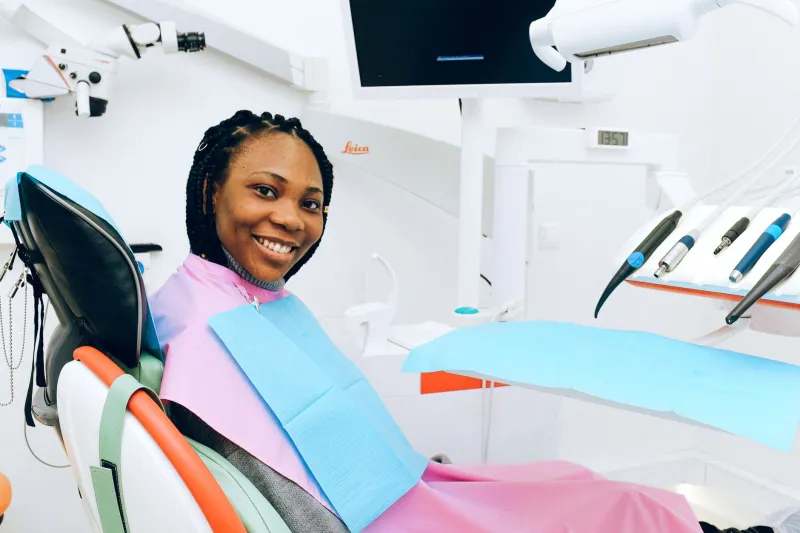
The family dentist with the wood-paneled waiting room and the fish tank has largely given way to a different model. Dental Service Organizations — corporate chains that own and manage practices across multiple locations — now control a growing share of the American dental market. The branding is slicker. The equipment is more advanced. The waiting room has a TV on the wall and a coffee machine in the corner.
But the bills have grown into something genuinely frightening for anyone without solid dental coverage. A single crown can run $1,500 out of pocket. A root canal plus crown can easily top $3,000. Cosmetic procedures — whitening, veneers, Invisalign — have become a massive revenue stream, blurring the line between healthcare and aesthetic enhancement. Dental insurance, where it exists, often covers a fraction of actual costs and caps annual benefits at levels that haven't meaningfully changed since the 1970s.
About 68 million Americans have no dental insurance at all. Emergency rooms across the country see millions of dental-related visits every year — people who can't afford a dentist and have nowhere else to go for an infected tooth.
Perfect Teeth as a Class Marker
There's a cultural dimension to all of this that's worth sitting with. Somewhere along the way, dental aesthetics became one of America's most visible class signals. Straight, white, perfectly aligned teeth aren't just healthy — they're a professional credential, a social passport. The rise of cosmetic dentistry has created a new standard that's effectively impossible for working-class Americans to meet.
Your grandparents' generation accepted a missing molar as a fact of life. Today's economy punishes people for it in job interviews.
The technical progress is real and undeniable. Nobody should romanticize the kitchen chair and the bottle of rye. But there's a legitimate question buried in all this advancement: did the professionalization and commercialization of American dentistry actually serve working people better, or did it simply build a more sophisticated system that's still just as out of reach for the people who need it most?
The tooth-puller in the feed store parking lot was terrifying. The $4,000 treatment plan on a tablet screen in a corporate dental chain isn't exactly a triumph either.
Somewhere between those two realities is the affordable, functional dental care that ordinary Americans were briefly promised — and that keeps quietly slipping further away.