America's Swimming Holes Dried Up and Nobody Noticed: How Summer Freedom Got a Price Tag
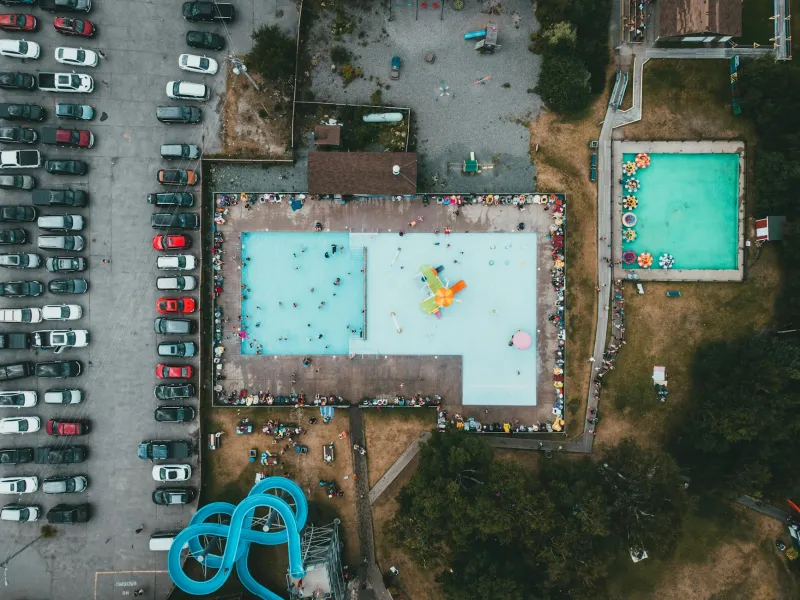
The Democracy of Deep Water
Every summer morning in 1970s America, kids across the country woke up with the same plan: grab a towel, maybe some lunch money, and head to the local pool. It didn't matter if your dad was a factory worker or a bank president—the municipal pool charged everyone the same fifty cents, and the swimming hole down by Miller's Creek was always free.
 Photo: Miller's Creek, via images.squarespace-cdn.com
These weren't just places to cool off. They were America's great equalizers, where children from every corner of town spent entire days together, supervised by lifeguards who knew every family and governed by unwritten rules that had been passed down through generations of summer afternoons. The concrete pools and muddy creek banks served as classrooms for lessons you couldn't learn anywhere else: how to make friends with strangers, how to navigate social hierarchies, and how to find your place in a community that extended far beyond your own backyard.
When Public Meant Everyone
Municipal pools were built during America's great infrastructure boom, when cities took pride in providing shared amenities that served every resident regardless of economic status. From the massive public pools of New York City to the modest community centers of small Midwestern towns, these facilities represented a collective investment in public leisure.
 Photo: New York City, via wallpapercave.com
The pools were staffed by locals—often high school students earning summer money or community members who took pride in maintaining a safe space for neighborhood children. Admission fees, when they existed at all, were deliberately kept low enough that any child with loose change from returning bottles could spend the day swimming.
Beyond the constructed pools, America's natural swimming spots created their own communities. Quarries, creeks, and lake access points became informal gathering places where families would arrive early to claim picnic tables and children would spend hours perfecting their cannonballs and racing across the water.
The Slow Drowning of Public Recreation
The decline didn't happen overnight, which is perhaps why so few people noticed it happening at all. Budget cuts in the 1980s and 1990s began targeting "non-essential" services, and public pools often topped the list of expendable amenities. Maintenance costs, insurance concerns, and liability fears provided convenient justifications for closures that were really about shifting public priorities.
As municipal pools closed, private alternatives emerged to fill the gap. Country clubs, fitness centers, and homeowner associations began marketing pool access as a premium amenity. What had once been a public right became a private privilege, available only to those who could afford membership fees that often exceeded what entire families once spent on summer recreation.
The natural swimming spots faced different pressures. Development consumed many traditional access points, while others were closed due to pollution, liability concerns, or simply the posting of "No Trespassing" signs by landowners who grew tired of managing informal public use.
The New Economics of Summer Relief
Today's families seeking swimming access face a dramatically different financial landscape. Day passes to private pools can cost $15-25 per person, turning a simple family outing into a $100 expense. Annual memberships to facilities with pools often run $1,500-3,000, placing them firmly in luxury territory for most American households.
Even the remaining public pools have transformed their pricing structures. Many now charge admission fees that would have seemed outrageous to previous generations, while others have been converted to revenue-generating aquatic centers with elaborate features that require higher maintenance costs and correspondingly higher prices.
The math is stark: a family of four visiting a pool twice a week during a ten-week summer season might spend $1,200-2,000 on what their counterparts in 1975 could have enjoyed for under $50.
What Sank Along with the Pools
The loss of accessible swimming facilities represents more than just recreational inconvenience—it marks the disappearance of one of America's most democratic social institutions. The old pools and swimming holes served as neutral territory where children from different neighborhoods, schools, and social classes naturally mingled.
These spaces fostered a particular kind of community supervision that has largely vanished from American childhood. Lifeguards and regular adult swimmers created informal networks of oversight that allowed children significant freedom while maintaining safety. Parents could send kids to the pool for entire days, confident that the community would keep an eye on them.
The swimming holes and public pools also served as training grounds for responsibility and independence. Children learned to navigate social situations without parental intervention, to resolve conflicts among themselves, and to take care of each other in ways that structured activities rarely teach.
The Ripple Effects of Private Water
As swimming access became privatized, it also became segregated—not by law, but by economics. Children now grow up swimming primarily with others from similar economic backgrounds, missing the social mixing that once defined American summer recreation.
The shift has also created new forms of childhood inequality. Swimming lessons, once offered free or cheaply at public facilities, now cost hundreds of dollars at private clubs. Water safety skills that were once nearly universal among American children have become markers of class privilege.
Meanwhile, the elaborate private pools and aquatic centers that replaced simple municipal facilities have created an arms race of amenities. Families feel pressure to join increasingly expensive clubs to provide their children with competitive swimming experiences, turning what was once casual recreation into serious financial commitment.
The Community That Evaporated
Perhaps most significantly, the privatization of swimming access eliminated one of the few remaining spaces where American families from different walks of life regularly encountered each other in relaxed, informal settings. The conversations between parents watching their children swim, the friendships that formed over long summer days, and the sense of shared investment in community recreation have largely disappeared.
The municipal pools of previous generations weren't just about swimming—they were about maintaining social connections across economic lines. They provided spaces where community members could observe and participate in each other's lives in ways that our increasingly segregated society rarely allows.
Today's children may have access to more elaborate aquatic facilities than ever before, but they've lost something that no amount of water slides or lazy rivers can replace: the experience of summer as a shared community resource, available to everyone and owned by no one.
The swimming holes are gone, the public pools have closed, and with them disappeared a piece of American summer that seemed so permanent that nobody thought to fight for it until it was already too late to save.