Bored Until Dinner: The Vanishing Art of Unscheduled Childhood
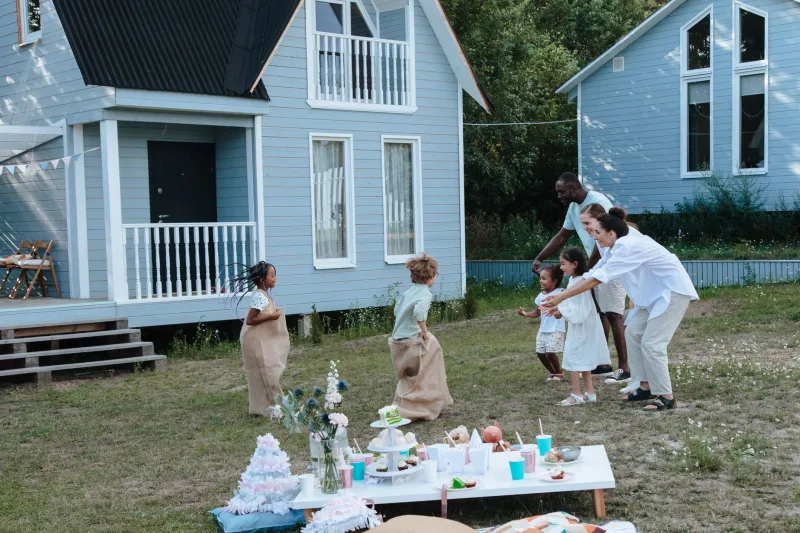
Somewhere around 1985, a mother in suburban Ohio opened the back door, told her seven-year-old to go outside, and didn't think about it again until she called him in for dinner. Nobody tracked his location. Nobody organized his activities. Nobody paid for his afternoon. He was just... out there. Figuring it out.
That scene plays like historical fiction now.
The Backyard as a World
For most of American childhood history, outdoor play was simple in structure and enormous in scope. You went outside. You found other kids — or you didn't. You built something, broke something, got into arguments that you resolved without adult mediation, fell off things, got back up, and eventually wandered home when the streetlights came on.
The geography was modest. A backyard. An alley. A stretch of sidewalk. Maybe a vacant lot with weeds tall enough to disappear into. But within those boundaries, kids constructed entire social universes. Rules were invented on the spot. Disputes were settled by negotiation or, occasionally, by someone going home mad and coming back twenty minutes later. There were no referees. There were no coaches. There were no liability waivers.
Boredom was the engine. When there was nothing to do, kids invented something to do. That process — sitting with discomfort, then generating a solution — turns out to be one of the most valuable developmental experiences a child can have. Researchers now call it self-directed play. Kids in the 1960s and 70s just called it Tuesday.
When the Fences Went Up
The shift didn't happen overnight. It crept in through a combination of real and perceived forces. Crime coverage expanded on local news in the 1980s and 90s, making neighborhoods feel more dangerous even when statistics told a more complicated story. Suburban sprawl replaced walkable blocks with cul-de-sacs designed for cars, not kids on bikes. Parents who had themselves grown up with total freedom began to feel, culturally, that allowing the same freedom made them negligent rather than normal.
And then came the scheduling.
Soccer leagues. Swim teams. Piano lessons on Wednesday. Art class Saturday morning. Coding camp in July. What began as enrichment quietly became expectation. A child with open afternoons started to seem like a child whose parents weren't paying attention — or worse, weren't invested in their future.
By the 2000s, researchers at Columbia and other institutions were documenting what they called the "overscheduled child." But the cultural momentum was already too strong. Free time had become something to be filled, not protected.
The Price Tag on Play
Here's where things get particularly striking: play didn't just get structured. It got expensive.
A generation ago, kids played in the backyard for free. Today, the average American family with children in organized activities spends somewhere between $700 and $2,500 per year per child depending on the sport or program — and that's before you factor in travel teams, private coaching, or specialized equipment. Summer used to mean freedom. Now it means camp deposits.
The irony is that despite all this investment, children today are getting less physical activity than their predecessors. The unstructured hours of running, climbing, and improvised athletics that filled previous generations' afternoons added up to more actual movement than a one-hour organized practice three times a week. Pediatric health organizations have been raising the alarm about declining physical fitness in children for over two decades. We scheduled play and somehow ended up with less of it.
What Got Scheduled Away
The developmental losses are harder to quantify but no less real. Clinical psychologists who study childhood development point to a cluster of skills that emerge specifically from unstructured, unsupervised play: conflict resolution, creative problem-solving, risk tolerance, emotional regulation. These aren't skills you can teach in a structured class. They develop through experience — specifically through the experience of navigating situations where no adult is going to step in and fix it for you.
A kid who figures out how to mediate a backyard argument at age eight is building neural pathways that a kid whose conflicts are always adult-refereed simply isn't. A child who climbs a tree that's slightly too tall is calibrating their own risk assessment in ways that matter for the rest of their life. Boredom, it turns out, is where creativity lives. When every moment is programmed, that creative muscle never gets used.
We've also lost something communal. The informal neighborhood kid ecosystem — where a ten-year-old naturally looked out for a seven-year-old, where mixed-age groups formed and dissolved organically — has largely disappeared. Children today tend to socialize in age-segregated, adult-supervised environments. The older kid teaching the younger kid how to throw a spiral, out of nothing but an afternoon and a football, is a rarer transaction than it used to be.
Safety Gained, Something Lost
This isn't an argument that everything was better before. Children genuinely were injured in unsupervised play in ways that better awareness and safety standards have since reduced. There are kids for whom structured programs provided access to sports and mentorship they wouldn't have found on their own. And the research on early childhood education suggests that some structured learning environments provide real cognitive benefits.
But the scale has tipped dramatically. We moved from a world where almost all childhood time was unstructured to one where almost none of it is — and we did it in roughly one generation, without fully examining what we were trading away.
The backyard hasn't changed much. It's still there. The grass still needs mowing, the fence is still slightly wobbly, and there's still a tree that's probably climbable if you're brave enough. What changed is the permission — the cultural permission for a child to walk out there with nothing to do and no adult watching and figure out what happens next.
That permission used to cost nothing. It might be the most expensive thing we've lost.