When Your Word Was the Contract: The America That Ran on Reputation
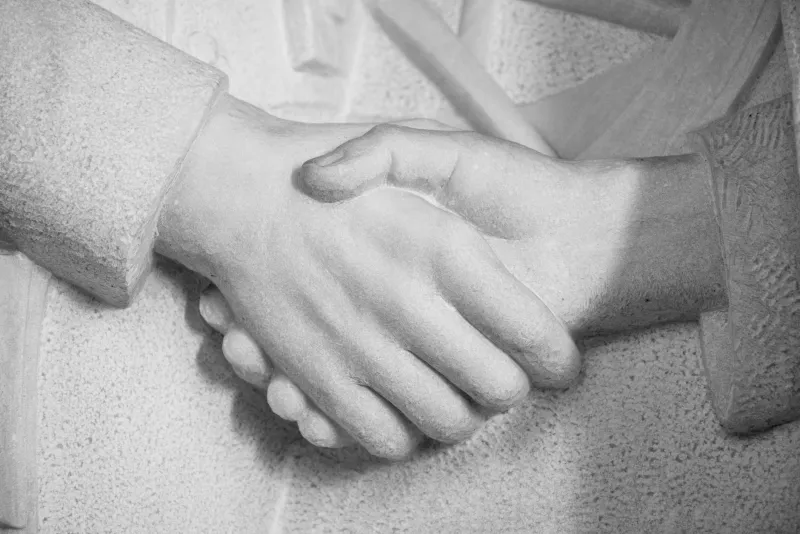
Sometime in the mid-1950s, a farmer in rural Indiana sold forty acres to his neighbor. They shook hands in a field. No attorney drafted a document. No title company ran a search. No escrow account held funds pending closing. The neighbor paid in installments when the harvest came in, and the farmer trusted that he would. The deed got recorded eventually, but the deal was done the moment their hands met.
That transaction sounds either impossibly quaint or recklessly dangerous, depending on when you were born.
The Economy of Reputation
For most of American history, commerce ran on something more personal than paperwork. In small towns and tight-knit communities — which described most of the country well into the mid-twentieth century — your reputation was a financial instrument. It had real value. It could open credit at the hardware store, secure a handshake loan from a neighbor, or land you a contract with a local business based on nothing more than the fact that everyone knew you and knew you were good for it.
The system worked because the consequences of breaking it were immediate and severe. If you stiffed someone on a deal in a town of three thousand people, everyone knew by the following week. You couldn't get supplies on credit. Nobody hired you for odd jobs. Your kids heard about it at school. The social and economic penalties for dishonesty were built directly into the community fabric, and they were more efficient than any court.
This wasn't nostalgia — it was infrastructure. The American economy of the nineteenth and early twentieth centuries was largely built on informal agreements, personal credit, and the kind of trust that only exists between people who have to look each other in the face regularly.
The Paper Trail Begins
The shift toward formalization came gradually and for understandable reasons. As America urbanized, the tight community networks that enforced informal agreements began to dissolve. You couldn't rely on reputation when your business partner lived across a city you'd only moved to three years ago. Commerce became anonymous faster than trust could adapt.
Legal liability expanded alongside corporate growth. When businesses scaled beyond the personal, they needed instruments that could survive the departure of any individual. A handshake between two men meant nothing when both men were replaced by their companies' successors. Contracts filled that gap.
The postwar economic boom added complexity. Transactions grew larger, more intricate, and more consequential. The stakes climbed high enough that nobody wanted to rely on goodwill alone. And as litigation became more accessible and more common in the latter half of the twentieth century, the cultural default shifted from trust to documentation. Not because people became less honest, but because the system stopped rewarding trust and started rewarding caution.
The Contractor Who Never Signed Anything
Ask anyone who grew up in a small American city or town before the 1980s and they'll tell you about some version of the same character: the local contractor, the mechanic, the plumber, the electrician who operated almost entirely on spoken agreements. He showed up when he said he would, charged what he'd quoted, and stood behind his work because his name was on it — not literally, but in the way that mattered.
Those arrangements weren't just convenient. They were faster, cheaper, and often produced better outcomes than today's heavily documented alternatives. There were no change order disputes because the relationship itself managed expectations. There were no invoice fights because both parties knew exactly what had been agreed. The work was the contract.
Compare that to a modern home renovation. Before a single wall gets opened, you're signing multi-page agreements, reviewing scope-of-work documents, navigating lien waivers, and potentially consulting an attorney. The paperwork exists to protect both parties — and it does — but it also adds cost, friction, and a layer of adversarial posturing that poisons the working relationship before it begins. The assumption embedded in every contract is that someone might cheat. That assumption shapes everything that follows.
What We Gained and What It Cost
Let's be clear: the formalization of American commerce produced real protections. Consumer rights exist because informal agreements left buyers vulnerable to unscrupulous sellers. Employment contracts protect workers from arbitrary dismissal. Real estate documentation prevents fraud and clarifies ownership in ways that verbal agreements simply cannot. The legal infrastructure that replaced the handshake economy wasn't built for no reason.
But the cost is worth acknowledging honestly. Small business formation has become more complex and expensive. Neighborhood-level commerce — the kind of transaction between two people who know each other — now requires the same apparatus as corporate deals. The friction of formalization falls hardest on people with the least access to legal resources, which means the protection that contracts theoretically provide is distributed very unevenly.
More subtly, the culture of documentation has changed how we relate to each other in commercial contexts. When every agreement needs a paper trail, the implicit message is that the other person cannot be trusted without one. That assumption, repeated enough times, becomes a self-fulfilling prophecy. We document because we don't trust. We don't trust partly because we've been trained by a system that treats distrust as the rational default.
The Thing a Signature Can't Replace
There's a reason people still talk about someone's word meaning something as a form of the highest praise. It's a relic of a system that no longer exists at scale, but the values it encoded — reliability, accountability, the willingness to be held to what you said — haven't lost their relevance. If anything, they've become rarer and therefore more valuable.
The handshake economy didn't work everywhere or for everyone. But it worked in enough places for long enough that its decline left something real behind. What we lost wasn't just a simpler way of doing business. It was a particular kind of social trust — the kind built through repeated, personal transactions in communities where your reputation followed you everywhere.
You can't sign your way back to that. But it's worth knowing what it looked like.