The Day the Whole County Showed Up: What Happened to America's Greatest Community Tradition
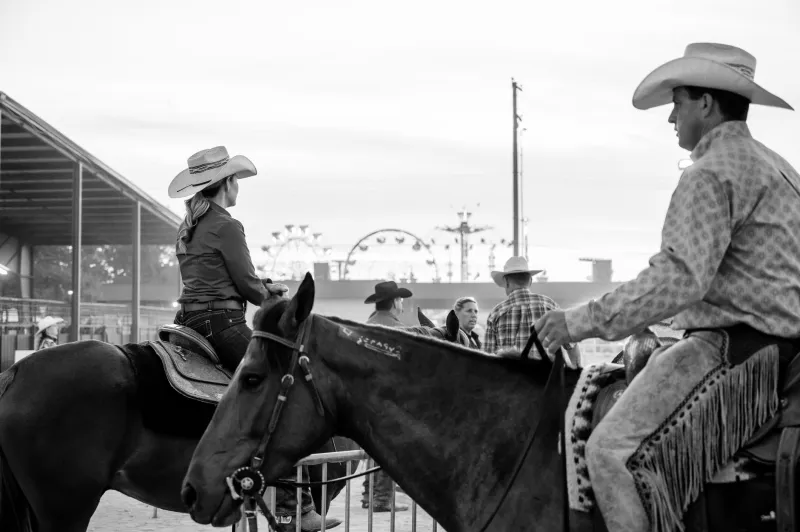
The Day the Whole County Showed Up: What Happened to America's Greatest Community Tradition
If you wanted to understand a county in mid-century America — its people, its values, its ambitions — you didn't read the local paper. You went to the fair.
For roughly a week every summer or fall, the fairgrounds became the center of everything. Farmers hauled their best livestock in trailers. Home cooks entered their preserves and pies into competitions judged by neighbors they'd known for thirty years. Kids who'd spent the summer raising a 4-H calf stood in the show ring in pressed shirts, nervous and proud in equal measure. And the whole community — every age, every income level, every background the county had to offer — turned up in the same place at the same time to watch it all happen.
This wasn't entertainment in the modern sense. It was something older and more essential than that.
More Than a Midway
It's easy to reduce the county fair to its most photogenic elements — the Ferris wheel silhouetted at dusk, the funnel cake, the ring toss games with their stuffed animal prizes. Those things were real and they mattered. But they were the decoration, not the structure.
The structure was agricultural and deeply serious. The fair existed, originally, as a practical institution. It was where new farming techniques got demonstrated. Where prize livestock set the standard for breeding programs across the region. Where the quality of a county's output was publicly measured and publicly celebrated. The ribbons meant something because the competition was genuine and the judges were experts.
Around that agricultural core, everything else accumulated. Commercial exhibitors set up booths. Local businesses advertised. Politicians showed up to shake hands because showing up at the fair was the single most efficient way to see their entire constituency in one place. Churches ran food stands. Schools displayed student work. The fair was, in the truest sense, a civic institution — one that reflected the community back to itself.
The Week the Calendar Revolved Around
For families in rural and small-town America through the mid-twentieth century, the county fair was the social anchor of the year. It was the event you planned around, saved for, and talked about after. Kids looked forward to it with the same intensity they brought to Christmas. Adults used it as a reunion — the one guaranteed week when you'd see cousins, old neighbors, and the farmer from the next township over who you only ever ran into here.
In many counties, schools simply closed for fair week. Local businesses reduced their hours. It wasn't a disruption to normal life. It was a scheduled suspension of normal life, collectively agreed upon, because everyone understood that the fair took priority.
That kind of communal prioritization is nearly impossible to imagine today. The idea that an entire county would, by informal consensus, agree to pause its routine for a shared event — not a disaster, not a national holiday, just a fair — speaks to a level of community cohesion that feels almost foreign now.
What Started Pulling People Away
The decline wasn't sudden, and it wasn't driven by any single cause. It was a slow erosion that began in earnest in the 1960s and accelerated through each subsequent decade.
Television arrived in American living rooms and brought entertainment that didn't require leaving the house. Then came air conditioning, which made the idea of spending a July afternoon in a hot livestock barn significantly less appealing. Interstate highways made it easy to drive to regional amusement parks — places with bigger rides, more polish, and a kind of manufactured spectacle the county fair couldn't match.
The agricultural foundation also shifted beneath the fair's feet. As farming consolidated and fewer families worked the land, the livestock competitions and crop exhibitions that had given the fair its purpose became less personally relevant to a growing share of attendees. The fair remained, but its reason for being felt increasingly distant to the suburban families who now made up the majority of the crowd.
By the 1990s, many county fairs were competing for attention against summer blockbusters, youth sports travel teams, and the early internet. They were no longer the only game in town. They were one option among many, and they weren't winning on spectacle.
What the Fairgrounds Became
Many county fairs still exist, and some draw impressive crowds. State fairs in particular — larger, better-funded, more capable of booking musical acts and building serious midway attractions — have held on with more success than their smaller county counterparts. Iowa, Texas, and Minnesota still treat their state fairs as genuine cultural events, and they're right to.
But the county fair — the local, intimate, this-is-our-community version — has largely faded into the background. Attendance figures at smaller fairs have dropped steadily for decades. Agricultural participation has thinned. The civic dimension, the sense that showing up was a form of community membership, has largely evaporated.
What replaced it? Honestly, nothing did. Not really. The void the fair once occupied — a shared annual moment that belonged to everyone, that required no ticket to a platform, no subscription, no algorithm to surface it — hasn't been filled by anything with the same character. We have more entertainment than ever and fewer genuine community rituals.
The Ribbon That Meant Something
There's a specific image worth holding onto when thinking about what the county fair represented at its best. It's a kid, maybe twelve years old, standing next to a steer she spent eight months raising. She's nervous. The judge is walking the ring. And when the blue ribbon goes to her animal, her parents in the stands react the way parents react at championship games.
The stakes were real. The community was watching. The work had been done in full view of people who understood what it meant.
That combination — genuine effort, community witness, shared standards — is rarer than it used to be. The fairgrounds may still be there. But the world that made them matter has largely moved on, and we're still figuring out what we traded it for.