The Message That Made You Sit Down First: How Waiting for News Once Made It Mean More
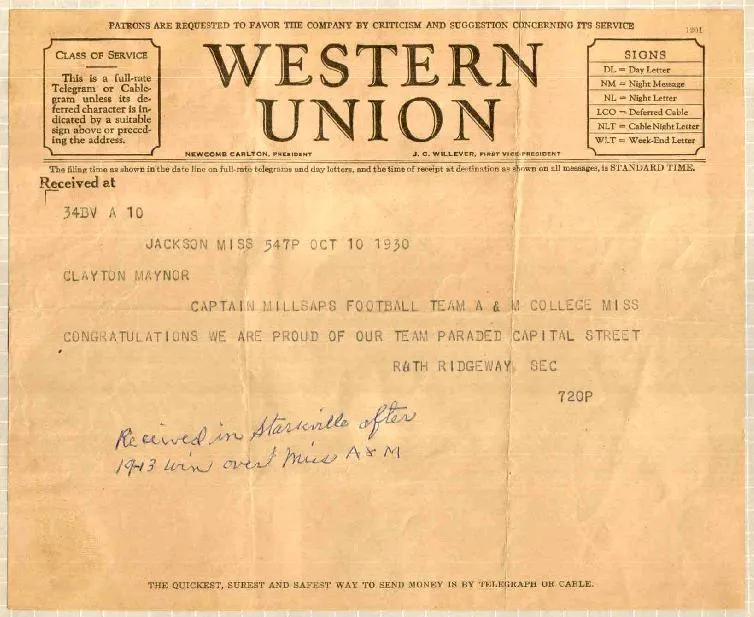
Photo: NatalieMaynor from Jackson, Mississippi, USA, CC BY 2.0, via Wikimedia Commons
There is a particular kind of photograph that shows up in American family albums from the 1940s and 1950s. A woman standing at a front door. A Western Union messenger on the step. Her hand raised to her mouth.
 Photo: Western Union, via www.creativosonline.org
You can't always tell from the image whether she's about to cry from relief or from grief. That ambiguity is the whole point. Before the message was opened, both possibilities existed simultaneously. The waiting — the days or weeks of not knowing — had already done its work on her. Whatever came next would land with full force because she had been carrying the anticipation of it for so long.
We live in a world now where news arrives before the moment has finished happening. And something about that is worth slowing down to examine.
The Architecture of Waiting
For most of American history, communication between people separated by any significant distance was a physical, time-consuming process. A letter mailed from a soldier in Europe during World War II might take two to three weeks to reach a family in Ohio. A telegram was faster — hours or a day, in many cases — but it still required a human being to carry it to your door, which meant the moment of delivery was its own distinct event.
Western Union alone handled approximately 200 million telegrams in 1945. These weren't just business dispatches. They carried news of births, deaths, marriages, homecomings, and heartbreaks. Each one was a small ceremony. The messenger arrived. You took the envelope. You found somewhere to sit before you opened it.
That pause — the few seconds between receiving the message and reading it — was a kind of threshold. People understood instinctively that life was about to be divided into before and after.
When Good News Felt Like a Gift
It's tempting to focus on the grief side of this equation — the dreaded War Department telegrams, the black-bordered envelopes. But the waiting shaped positive news just as profoundly, and in ways that are genuinely hard to recreate today.
Consider what it meant for a family to learn that their son was coming home from overseas. The news didn't arrive as a notification while someone was scrolling through their phone during a commercial break. It arrived as an event — a specific moment, often shared with whoever happened to be in the room. People called neighbors over. They sat together. They read the words aloud more than once, as if repetition could help them absorb something so large.
The wait itself had been a kind of collective experience. The whole family had been carrying the uncertainty together. When the relief finally came, it landed inside that shared emotional context, and it meant more because of everything it had cost them to get there.
A baby born to a family while the father was away at work — in an era before cell phones — meant someone physically drove to his office or his job site to tell him. He had to stop what he was doing. He had to travel home. He arrived as a father for the first time after a journey, however short, that gave him space to begin becoming the person this news required him to be.
The Speed We Chose
The shift happened in stages. Long-distance phone calls became affordable in the 1970s. Fax machines compressed business communication in the 1980s. Email arrived and began flattening the emotional texture of personal correspondence in the 1990s. And then the smartphone finished the job, delivering every category of news — a death in the family, a job offer, a diagnosis, a birth — as a small buzz in someone's pocket.
We chose this. Or at least, we accepted it enthusiastically each time a new option arrived. Faster was obviously better. Why would anyone want to wait?
But speed has hidden costs, and one of them is the compression of emotional experience.
When a birth announcement arrives as a group text before the new parents have left the delivery room, it becomes ambient information rather than a moment. Recipients process it in seconds while doing something else. They send a heart emoji and move on. The news is shared, technically, but the ceremony around it — the gathering, the telling, the weight of the moment — has been skipped entirely.
What Anticipation Actually Did
Psychologists who study emotion have noted for decades that anticipation is not simply the absence of information. It is an active state — one that prepares people emotionally for what's coming, that builds meaning around events before they arrive, and that creates the conditions under which joy or grief can be fully processed.
The soldier's family who had been waiting three weeks for a letter wasn't just impatient. They had been living with the stakes of that news for three weeks. They had thought about it, prayed about it, talked about it with each other. When the letter finally came, they were ready to feel it completely.
Compare that to learning your college roommate just had a baby via an Instagram story you happened to catch between two other posts. The information registers. But it doesn't land the same way. It can't.
The Trade We Made
None of this is an argument for returning to telegrams or rationing information to make it feel more significant. The speed of modern communication saves lives, enables connection across distances that once meant permanent separation, and has compressed the cruelty of uncertainty in ways that genuinely matter.
But it's worth acknowledging that we didn't just gain speed. We also gave something up — a texture of experience, a weight to moments, a way of receiving news that made the news itself feel proportionate to its importance.
The Western Union messenger at the door wasn't just delivering a message. He was delivering a threshold. And on the other side of it, whatever came next, people were ready to feel it fully.
We're faster now. We're just not always sure we're deeper.